

Worn for years.
A jade bangle is not resized, and rarely taken off. You choose it once — the size, the shape, the stone — and then you live in it. Which is exactly why it is worth choosing slowly.
It has to pass the hand, then rest on the wrist.
A solid jade bangle does not open, so it has to clear the widest part of your hand to go on — and then sit easy on the wrist without sliding off. Too loose and it knocks and chips; too tight and it never goes on at all. To find your size at home: bring your thumb across to meet your little finger, as if slipping the bangle on, and measure around the widest part of that bunched hand in millimetres. That figure, near enough, is the inner circumference you need; divide it by 3.14 for the inner diameter most bangles are sold by.
As a rough guide, inner diameters of 50–52mm read as small, 54–56mm as medium, and 58mm and up as large — but hands are not charts. A bangle is worn for years and cannot be altered, so the size is the one thing worth confirming in person, on your own wrist, before anything is decided.
Round (classic)
Fully round inside and out — the traditional form, and the one most often passed down. It turns freely on the wrist and catches the light from every angle.
Oval (“princess”)
An oval inner shape that slips over a wider hand more kindly and sits flatter against the wrist. Often the easier choice for an everyday bangle.
Flat / D-shape
Rounded on the outside, flat against the skin. The most comfortable for constant wear, and quiet under a sleeve.

A bangle you keep is a stone worth keeping.
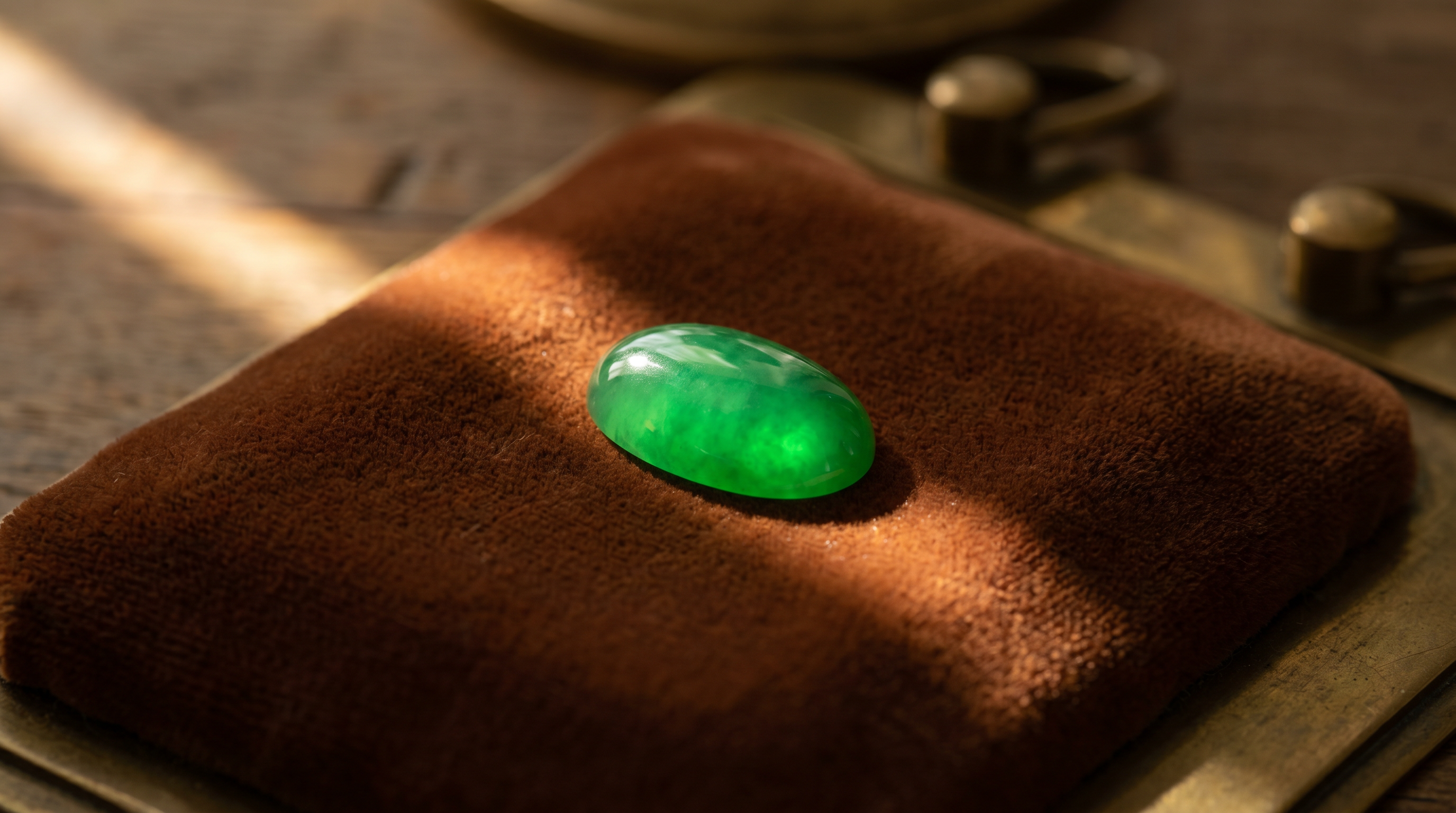
Size and shape decide how a bangle wears; the stone decides whether it is worth wearing at all. Hold it to the light — fine jade glows from within rather than sitting flat and opaque — and look for an even, natural colour that is not pooled along the cracks. Above all, ask whether it is Type A: natural jade, untreated. Type B and C bangles can look the part on the day and yellow or dull within years. If you want the longer version, our note on what sets jade’s value walks through it.
The right bangle is the one you forget you are wearing, and would not be without.
Blaise Huxley · On CraftTradition says the left. Comfort settles the rest.
By custom, a jade bangle is worn on the left wrist — the hand most people use less, both to spare the stone and, in Chinese tradition, because the left is the receiving side, nearer the heart. It is custom, not rule. Many simply wear it on whichever wrist is slimmer, so it sits well and stays on. What matters more than the hand is the fit: a bangle that clears the hand cleanly and rests without straining is one you will keep on for good.
A piece meant to be handed on.
A jade bangle has long been given to mark a beginning — a daughter, a wedding, a milestone — and worn for decades, often passed from one wrist to the next. That is part of why the choosing is unhurried: it is not a piece for a season, but one a person grows into and, in time, leaves to someone else. Choose the size for the wrist it will live on, the stone for what it is, and it becomes exactly that kind of object.
Sized to your wrist, chosen for the stone.