

One letter decides.
When jade is graded A, B or C, the letter has nothing to do with colour or quality. It describes what has — or has not — been done to the stone. And it is the difference between a piece that holds its value and one that quietly loses it.
The letter is about honesty, not grade.
It is the most misread label in jade. Type A is not 'the best quality', and Type C is not 'the worst' — the grades describe treatment. A is untouched. B and C have been altered to look better than the stone is on its own. A fine green Type A and a pale Type A are both Type A; what they share is that nothing has been added, and nothing taken away.
Natural
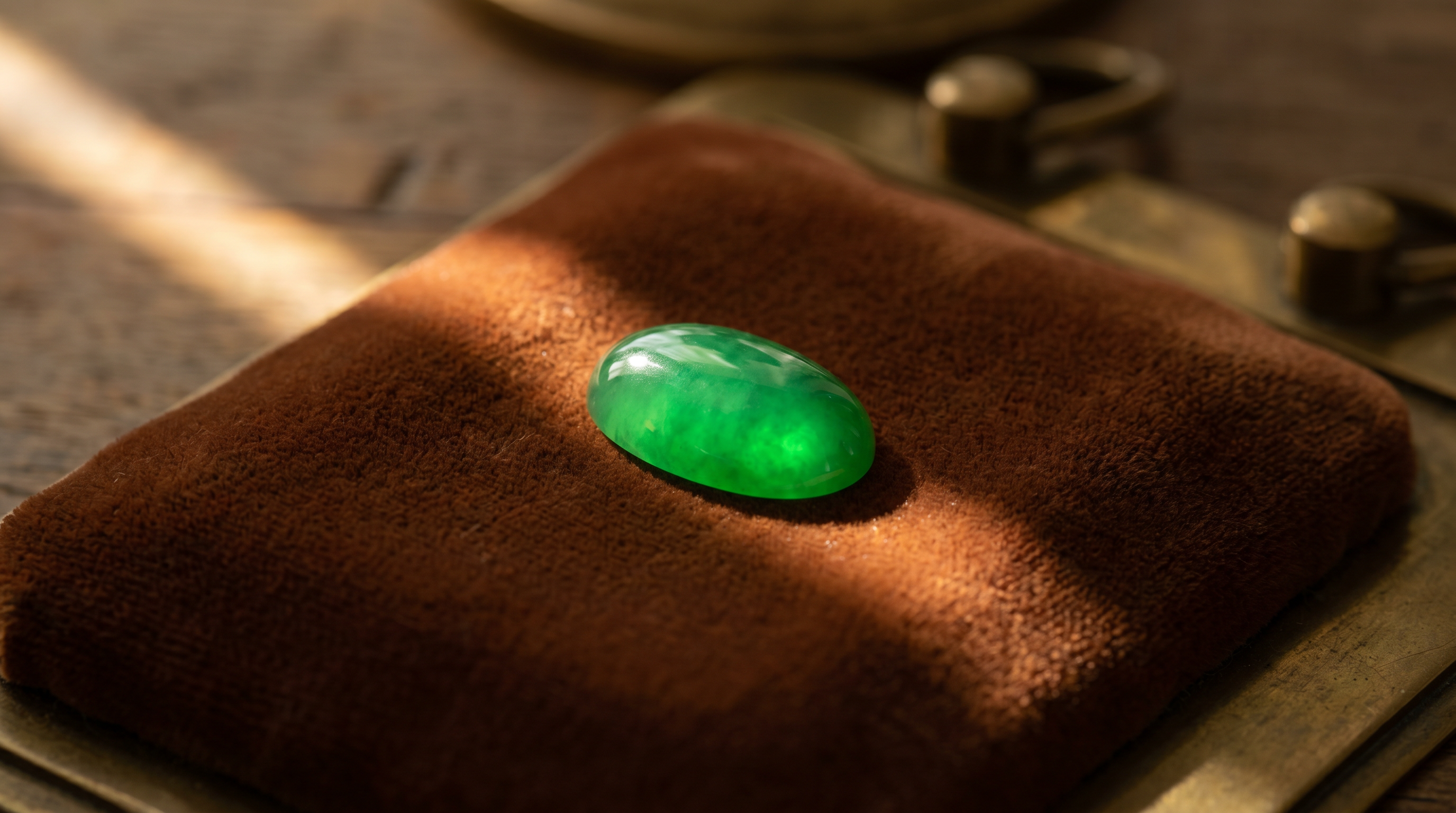
Only cut and polished — bleached of nothing, filled with nothing, dyed with nothing. The colour and the translucency are the stone's own. This is the only jade bought to keep.
Bleached & filled
Acid-bleached to strip impurities, then impregnated with polymer to restore clarity. Convincing at first, and far cheaper — but the resin yellows and grows brittle over the years.
Dyed
Colour the stone never had, added and often prone to fade. Frequently combined with B treatment and sold as B+C. Real jade by mineral — but not what it appears to be.

Only Type A holds its value.
Treatment is not only a question of honesty; it is a question of how a piece ages. Type A jade is stable — it keeps its colour and its surface for generations, which is why it is the only kind worth passing on. B and C jade can look almost identical on the day you buy it, and noticeably less so a decade later. That gap is the whole reason the grades exist.
Type A is not a grade of beauty. It is a grade of what is real.
Blaise Huxley · On CraftYes — and it is what value is measured against.
Type A jade is one hundred per cent natural jadeite, and it sits at the top of the market — fine, even, translucent green most of all. B and C jade are still jade by mineral, but treated, and priced for it. So: is Type A jade real? More real than any other grade. Is it valuable? It is the grade every other grade is discounted from.
Ask for the letter, in writing.
Some signs are visible — B jade can show a faint network of etched lines under a loupe, dyed C jade can pool colour along its fractures — but none of it is conclusive by eye. For anything of real value, the only certainty is a report from a gemological laboratory stating the type. The honest move is the simple one: ask whether a piece is Type A, and ask for it in writing. A seller with nothing treated has nothing to hide.
Bought once, and kept — that is what Type A is for.